AI search answers in your reader's language — then cites someone else
Across 3.25 billion AI citations and 16,000 test answers, the language of the question — not the reader's country — decides which sites get cited. The evidence, and what it means for English-only content.
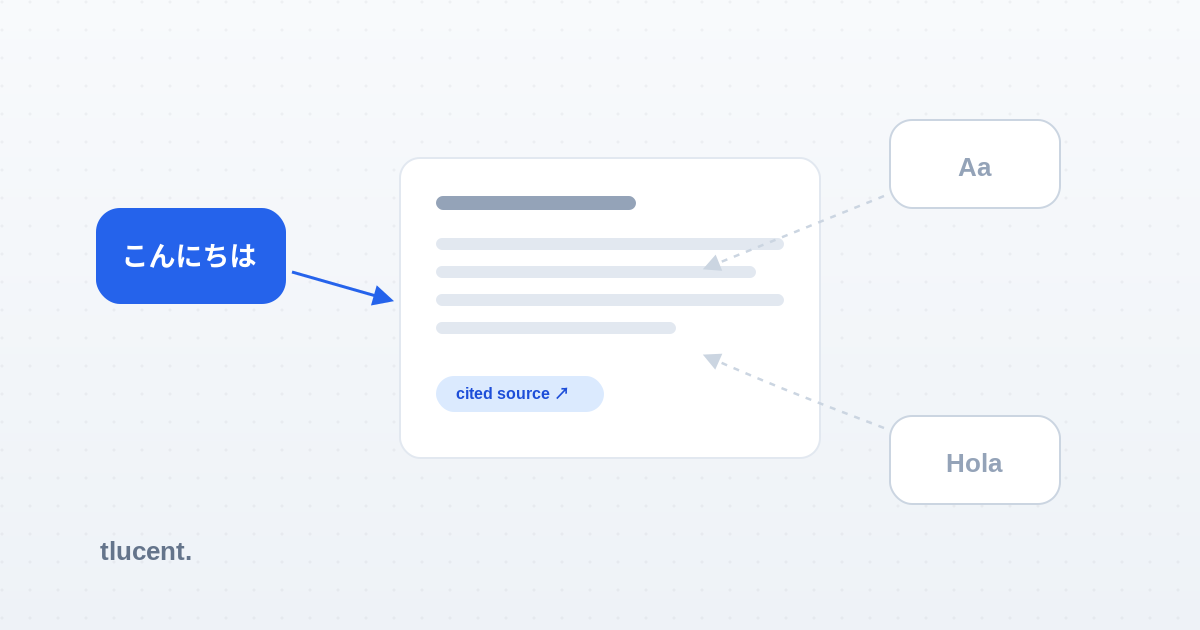
If someone in Osaka asks ChatGPT a question in Japanese, and your answer only exists in English, you are very likely not in that answer. Not because your content is worse. Because of how these systems retrieve.
We spent a while reading the primary research on this — search engine documentation, crawler operator docs, peer-reviewed papers, and the handful of large-sample studies that actually measure citations rather than speculate about them. A few findings were strong enough, and counterintuitive enough, to be worth writing down with their sources attached.
1. The language of the question, not the country of the reader
The largest measurement we found is from Profound: 3.25 billion AI citations, seven models, fourteen countries, filtered so that each country’s queries were asked in that country’s primary language (Brazil in Portuguese, Japan in Japanese), with US/UK/AU as the English baseline.
Their conclusion:
a country’s geography is secondary to a much more powerful force: the language of the query.
That is the whole game in one sentence. A reader in Tokyo asking in English and a reader in Tokyo asking in Japanese are, from the retrieval system’s point of view, in two different information markets. Your content is either present in the second one or it is not.
2. How big is the gap? About 26× in Japan
Weglot ran 400 questions × 4 languages × 4 AI systems × 5 countries — over 16,000 answers — and looked at which domains got cited.
In Japan:
- Questions asked in Japanese: 26% of citations went to
.jpdomains - The same questions asked in English: about 1%
Narrowed to government and academic domains (.go.jp, .ac.jp) the ratio holds: 4.26% versus 0.13%.
This is worth sitting with. It is not a small preference. Asking in the local language moves roughly a quarter of the citation pool to local domains — a pool that English-only content is structurally excluded from.
The same study found something that cuts the other way, and we would rather state it than hide it: English-language questions surface more sources in every market. English content has a real, structural head start in raw citation volume. Publishing in more languages does not make that go away; it makes you eligible for the local-language pool you are currently outside of.
3. Even non-English questions get researched in English
Peec AI analysed 10 million ChatGPT searches and found that when a user asks in German, Polish, or Spanish, the model’s own background research is often not in that language:
nearly half of this research happens in English, even when the original question wasn’t in English
Their worked example is instructive. A Spanish-language question about the best cosmetics brands fanned out to an English query on the first hop — “best cosmetic brands skincare makeup top brands” — and the resulting answer contained zero Spanish brands. Every citation was an English-language site.
So the retrieval layer is not simply “local language in, local language out”. It is messier, and the mess mostly disadvantages non-English publishers, including the local ones who should have won that answer.
As Peec put it: 80% of internet users do not speak English as their first language, and this affects all of them.
4. The platforms themselves get multilingual URLs wrong
Glenn Gabe (GSQi) tested this directly, using Google’s own documentation site — which has complete, correct hreflang annotations — as the subject, across seven platforms:
| Platform | Returns the correct language version? |
|---|---|
| Google (ten blue links) | Consistently correct |
| Bing | Correct in every test |
| Google AI Mode | Mostly correct |
| Google AI Overviews | Usually correct, occasional English fallback |
| Copilot | Correct (Bing-based) |
| Gemini | Often gives no source; correct version on follow-up |
| ChatGPT | Answers in French or Italian, links the US English page |
Read that last row carefully, because it is the practical failure mode: the assistant is already speaking your reader’s language. It just has no correctly-annotated page of yours to point at, so it points at your English one. The reader lands somewhere they cannot read, from an answer they could.
Two things follow. First, hreflang is not a legacy SEO chore in this world — it is the annotation that tells these systems which version to surface. Second, the annotation is useless without a page behind it.
5. What does not work: JavaScript, and llms.txt
Two widely-repeated tactics do not survive contact with the data.
AI crawlers do not run JavaScript. Vercel and MERJ instrumented this at scale: GPTBot, ClaudeBot, PerplexityBot, and CCBot all fetch without rendering. If your translation happens in the visitor’s browser — a widget, a client-side locale switcher, an SDK that swaps strings after load — the crawler sees the source language. Every time. Whatever a human sees is irrelevant to what gets indexed.
llms.txt is, so far, not read by anyone. Ahrefs checked 137,000 domains: of roughly 38,000 valid llms.txt files, 97% received zero requests in a full month. It may matter later. It does not appear to matter now, and it is not a substitute for having crawlable content.
6. The honest caveat: this is a leveller, not a multiplier
The peer-reviewed work here is the KDD’24 GEO paper, and its central result is one that vendors in this space tend to leave out:
- For a site sitting at rank 5, generative-engine optimization produced up to +115% visibility
- For the site at rank 1, the same techniques were negative — about −30%
GEO is a rank equalizer. If you are already the dominant result for your topic in your main market, this is not where your next win comes from. If you are invisible in a market — which is exactly the position English-only content is in for every non-English query — the upside is real and large.
Ahrefs’ 300,000-keyword study adds the boundary condition: AI Overviews cut the click-through rate of the first organic result by 34.5%, but 76% of AI citations still come from pages in the top 10. Classic ranking still gates eligibility. Nothing here replaces being indexable and good; it decides which version of you is eligible.
What we take from this
Putting the findings together, the requirement is narrower than “do GEO”:
- A page has to exist in the reader’s language, at a stable URL.
- It has to be served in that language to a crawler that does not run JavaScript.
- It has to be annotated so the platform knows which version to cite.
- It has to be indexable in ordinary search, because that is still the gate.
None of that is exotic. It is also, for most teams, a quarter of engineering work they keep deferring — which is roughly why we built tlucent. You point a DNS record at us and your existing site becomes available in the languages you choose, server-side, with hreflang and canonical annotations generated for you, and no JavaScript between a crawler and your words.
This article is our own test case. If you are reading it in a language other than English, you are reading tlucent’s output, on our own site, served the same way it would be served on yours. That is the only product claim we will make here — the rest of the page is other people’s data, linked so you can check it.
Sources
All primary, all linked. We have cited the studies as their authors published them, including the ones run by companies we compete with.
- Profound — How query language reshapes AI citations (3.25 billion citations, 7 models, 14 countries)
- Weglot — AI search citations by language and country (16,000+ answers)
- Peec AI — ChatGPT searches in English even when you don’t (10M searches)
- Glenn Gabe / GSQi — AI search, hreflang and multilingual queries
- Vercel × MERJ — The rise of the AI crawler (~1.3 billion AI fetches in a month)
- Ahrefs —
llms.txtstudy (137,210 domains) and AI Overviews reduce clicks (300,000 keywords) - Aggarwal et al., GEO: Generative Engine Optimization, KDD ‘24 — arxiv.org/abs/2311.09735
- Google Search Central — AI features and your website