Why not i18n catalogs: The hidden engineering tax of runtime translation files
i18n catalogs convert localization into an engineering tax—key extraction friction, CI bloat, missing-key fallbacks, and cross-team sync delays. Edge localization takes content out of the build pipeline entirely.
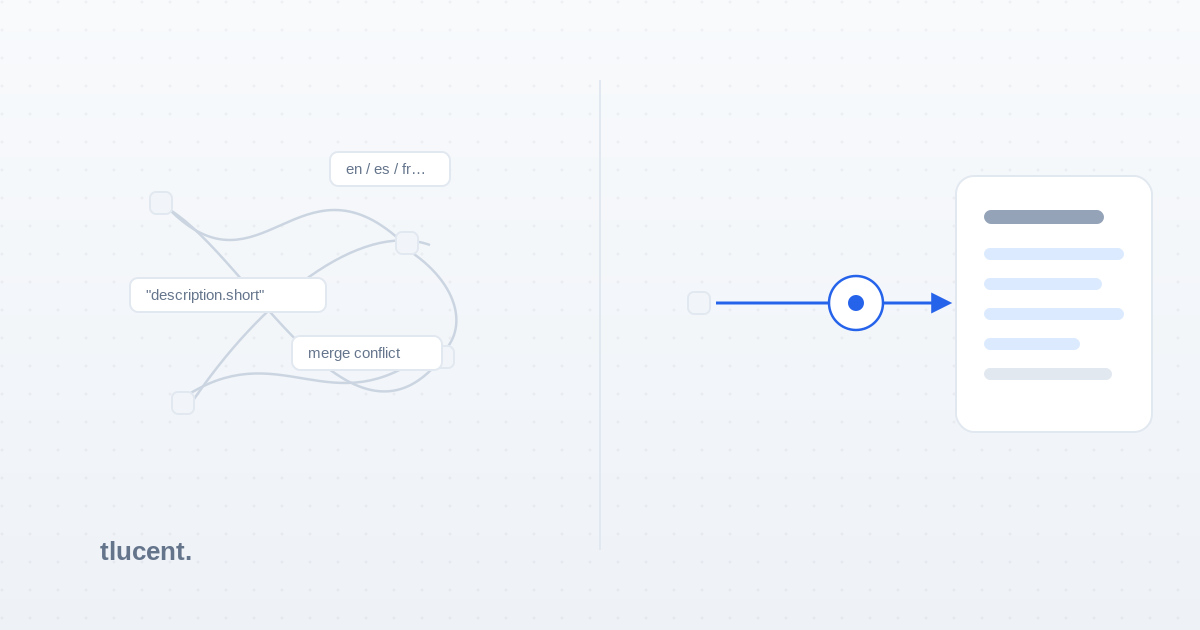
Your localization workflow is slower than you think.
Every time a developer writes t('product.description.short'), they’re making a choice: embed translation logic into application code, maintain JSON dictionaries per locale, and rebuild the entire bundle when marketing changes a headline.
This is the engineering tax of runtime i18n catalogs—and most teams don’t realize they’re paying it until they try to scale.
The i18n catalog pattern: what it actually costs
Let’s trace what happens when your marketing team needs to update a product description across 5 languages.
Step 1: Translation handoff
Marketing writes the new copy in English. Someone (usually a product manager or localization coordinator) extracts the relevant keys from your i18n JSON files:
// en/product.json
{
  "product": {
    "description": {
      "short": "Premium wireless headphones with active noise cancellation",
      "long": "Experience studio-quality sound wherever you go. Our flagship headphones feature..."
    }
  }
}
They send this to a translation management system (TMS) or agency. Wait 2–5 business days for translations.
Step 2: Git merge hell
Translations come back. A developer opens a PR:
+ "description.short": "Auriculares inalámbricos premium con cancelación activa de ruido",
+ "description.long": "Experimenta sonido de calidad de estudio dondequiera que vayas..."
But wait—three other developers have been working on features that touched product.json this week. Now you have merge conflicts in:
en/product.json(someone addedproduct.reviews.empty_state)es/product.json(someone fixed a typo inproduct.price.tax_included)fr/product.json(someone renamedproduct.description.detailed→product.description.long)
Resolution time: 30–90 minutes per PR, depending on how many keys shifted.
Step 3: CI build explosion
Your build pipeline now needs to bundle 5 separate locale files (en, es, fr, de, ja). Each is 100–300 KB of JSON, parsed and embedded into your JavaScript bundle.
For a Next.js app with 500 pages, that’s:
Build output per locale:
- Static page HTML: ~50 MB total
- i18n JSON bundles: ~25 MB total (5 locales × 5 MB average)
- Build time: 8–12 minutes (was 4 minutes before you added German)
Every commit triggers a full rebuild. Deploy frequency drops from “merge to main” to “batch changes twice a day.”
Step 4: The missing-key lottery
A translation key is missing in de/product.json because the German translation PR hasn’t merged yet. The app falls back to English—but only for that one string. Users see:
“Premium wireless headphones with active noise cancellation"
"Experimenta sonido de calidad de estudio…” ← still English
”Livraison gratuite” ← French, because someone forgot to update the footer
Support tickets pile up: “Why is my checkout page half in English?”
Step 5: The sync delay
Marketing launches a flash sale. The new banner copy needs to go live in 2 hours. But the translation workflow takes 2–5 days.
Decision: launch in English only, or hardcode the copy and create a tech debt ticket to “move to i18n later” (it never happens).
This is the engineering tax. It’s not the cost of translation itself—it’s the friction of keeping content in sync with code.
Code comparison: nested keys vs. untouched semantic HTML
Let’s look at what this looks like in practice.
With i18n catalogs (react-i18next / next-intl)
// components/ProductCard.jsx
import { useTranslation } from 'react-i18next';

export function ProductCard({ product }) {
  const { t } = useTranslation('product');

  return (
    <article className="product-card">
      <h2>{t('product.name', { defaultValue: product.name })}</h2>
      <p className="description">
        {t('product.description.short')}
      </p>
      <div className="price">
        {t('product.price.currency', { defaultValue: '$' })}
        {product.price}
        {t('product.price.tax_included', { defaultValue: ' (tax included)' })}
      </div>
      <button aria-label={t('product.cta.add_to_cart')}>
        {t('product.cta.add_to_cart')}
      </button>
    </article>
  );
}
Problems:
- Cognitive overhead: Every visible string requires a
t()call with an arbitrary key path. - Default value sprawl: Developers add
defaultValuefallbacks, duplicating content across code and JSON. - Refactoring risk: Rename a key in JSON → silently break components. Zero compile-time safety.
- Content ownership blur: Is
product.description.shortowned by engineering or marketing? Who can change it without a full production deployment?
With edge-layer localization
// components/ProductCard.jsx
export function ProductCard({ product }) {
  return (
    <article className="product-card">
      <h2>{product.name}</h2>
      <p className="description">{product.description}</p>
      <div className="price">
        <span>$</span>{product.price}<span>(tax included)</span>
      </div>
      <button>Add to cart</button>
    </article>
  );
}
The component returns 100% clean, standard semantic HTML. No translation hooks, no artificial keys, no markup pollution.
Translation happens at the edge network (e.g. Cloudflare Workers) on the rendered response stream before it reaches the browser or search crawler.
Benefits:
- Zero build step for copy changes: Marketing updates product copy; the edge delivers localized text instantly.
- Zero JSON bloat in JS bundles: Client JavaScript bundles stay lean; no megabytes of locale dictionaries downloaded on page load.
- Zero git merge conflicts: Content changes never touch application repository commits.
- Real indexable URLs for every locale:
/en/product/123,/de/product/123,/ja/product/123are distinct server responses complete with matchinglangtags, metadata, and hreflang clusters.
The maintenance cost model
Let’s quantify the engineering tax for a mid-size team.
Assumptions:
- 5 locales (en, es, fr, de, ja)
- 500 pages (product pages, marketing landing pages, help docs)
- 4 engineers, 1 product manager, 1 localization coordinator
- Average engineer salary: $150k/year, an effective cost of about $150/hour once benefits, overhead, and the opportunity cost of engineering time are counted
Annual cost of i18n catalogs:
| Activity | Frequency | Time per occurrence | Annual hours | Annual cost |
|---|---|---|---|---|
| Extract keys for translation | Weekly | 1 hour | 52 | $7,800 |
| Review and merge translation PRs | Weekly | 2 hours | 104 | $15,600 |
| Resolve merge conflicts in JSON files | Monthly | 1 hour | 12 | $1,800 |
| Debug missing-key fallbacks | Monthly | 2 hours | 24 | $3,600 |
| Rebuild and redeploy for content changes | Daily | 10 minutes | 60 | $9,000 |
| Coordinate with marketing on content freezes | Monthly | 3 hours | 36 | $5,400 |
| Total | 288 hours | $43,200 |
That’s $43,200/year in engineering time spent on localization workflow—not on translation itself, but on the friction of keeping content in sync with code.
For larger teams (10+ locales, 1000+ pages), this easily reaches $80k–$120k/year.
What still belongs in client-side i18n
Let’s be completely clear about engineering boundaries. Edge localization is not a silver bullet for every string in your codebase.
Client-side i18n catalogs are still the right tool for:
- Form validation messages: “This field is required”, “Invalid email format”
- Authentication UI states: “Signing in…”, “Session expired”
- Transient error states: “Network error, retry in 5s”, “Card declined”
- Highly dynamic client-side widgets: Rich date pickers, canvas tools, interactive calculator steps
These are application state messages—they depend strictly on runtime logic, client-side input validation, and reactive UI state. They belong inside application code.
Content should never be trapped in i18n catalogs:
- Product titles and descriptions: Updated continuously by catalog and merchandising teams
- Landing pages and campaign banners: Time-sensitive, campaign-driven
- Blog posts, documentation, and customer stories: High-volume, SEO-critical
- Policy and pricing explanations: Business-owned, not feature-dependent
This is content—business-owned, frequently updated, and critical for organic search and AI citations. It should never require an engineering deploy to update.
How edge localization works in practice
Edge workers (such as Cloudflare Workers) intercept requests at the CDN layer and handle localization on the stream before delivering it to visitors and AI crawlers:
- Origin Build: Origin serves clean semantic HTML in the primary language.
- Edge Interception: The edge detects the target market from the path (e.g.
/de/,/ja/) or headers. - Translation Memory & Streaming: Pre-translated strings from edge translation memory are streamed into the response with sub-50ms latency.
- Search Engine & AI Crawler Delivery: Crawlers (Googlebot, Claude-SearchBot, PerplexityBot) receive fully rendered, localized HTML on genuine distinct URLs.
// A conceptual Cloudflare Worker using HTMLRewriter
export default {
  async fetch(request, env) {
    const url = new URL(request.url);
    const locale = url.pathname.split('/')[1] || 'en';

    // Fetch untouched origin HTML
    const originResponse = await fetch(request);
    if (locale === 'en' || !originResponse.headers.get('content-type')?.includes('text/html')) {
      return originResponse;
    }

    // Stream and localize text nodes at the edge
    return new HTMLRewriter()
      .on('title, h1, h2, p, button, a', new TextLocalizer(locale, env))
      .transform(originResponse);
  }
};
No build step for content updates. No megabytes of JSON catalogs in JavaScript bundles. No merge conflicts.
The decision framework
Ask your team four questions:
- Who owns the copy? If it’s marketing or merchandising, not engineering → Edge localization
- How often does it change? If it’s weekly or campaign-driven, not quarterly releases → Edge localization
- Does it depend on client state? If it’s static product/marketing content, not form validation logic → Edge localization
- Do you need real URLs for international SEO and AI search? If yes → Edge localization
If you answered “Edge localization” to 3 or more questions, keeping all your content in i18n catalogs is an expensive engineering tax.
Conclusion
Runtime i18n catalogs made sense when client-heavy Single Page Applications ruled and content was inextricably coupled to JavaScript state. In 2026, with mature edge computing and global content demands, using code PRs to edit translated copy is an architectural anti-pattern.
The engineering tax is real: $43k–$120k/year in wasted workflow friction, merge conflicts, and deploy delays.
The modern architecture separates concerns:
- Keep application state and form errors in client code.
- Move international content and catalog pages to the edge.
Your developers stop resolving JSON merge conflicts. Your marketing team ships international campaigns without waiting for sprint deploys. And your site shows up with real, indexable URLs across every language your customers speak.
Curious how edge localization plugs into your existing stack with a single DNS record? Explore the live demo to see your store translated on real URLs.