Pricing explained: characters translated, and translated page views
Two units, and what each one is for. Characters translated is the one-time cost of putting a page into a language. Translated page views is what it costs to hand those pages to readers.
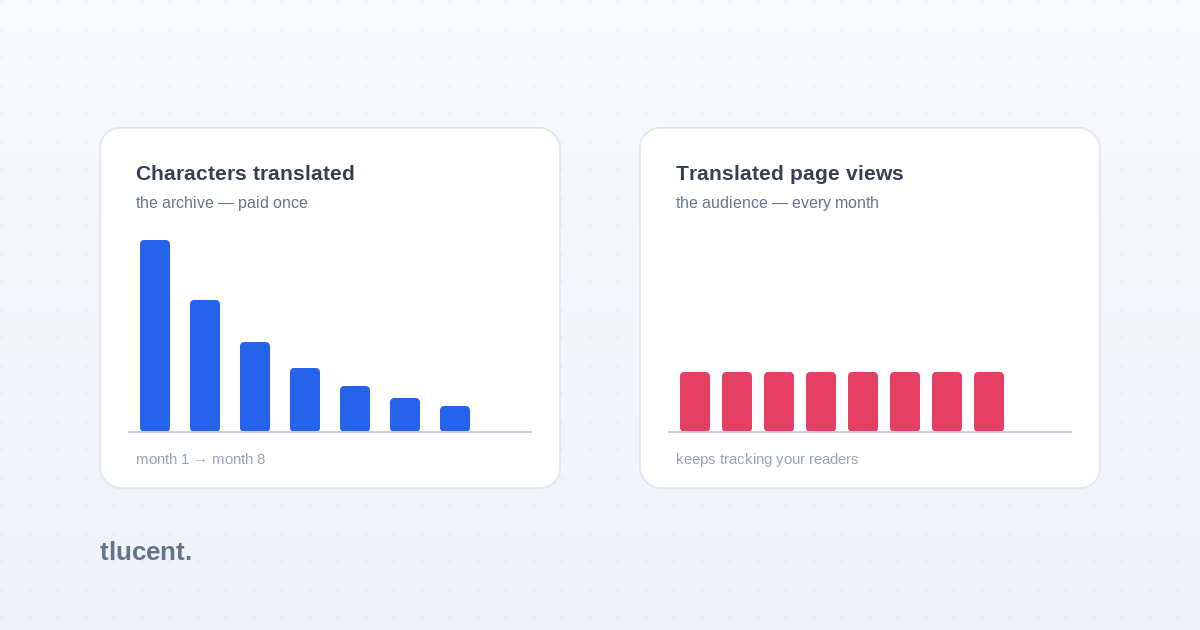
Most translation pricing is shaped like the tools that came before it. Documents have a page count, so traditional translation memory tools charge by document. Translators have seats, so platform tools charge per seat. Both are reasonable for the shape of those products. Neither describes what actually happens when your live site is translated as readers load it: one cost that ends, and one that grows with your audience.
So we meter two units, and we say plainly which is which. Together they cover the full metered surface — characters for the one-time work of putting your content into each of up to 80 languages, and page views for the ongoing work of handing those pages to readers.
Unit one: characters translated
A character is a source character we send to the translation model the first time a page enters a language. In practice that is the text we extract from your page — visible text, alt text, meta descriptions, link titles — counted once, per target language. Output length does not affect the bill; we pay for generating it, but the unit we meter is your source text, which is a number you can estimate before you publish.
We do not bill characters for HTML markup, CSS, JavaScript, or image bytes. We do not bill characters for a page served from cache, for text translation memory already holds, or for a translation that failed. If a sentence in your page was already translated for a different URL, we do not pay the model again and we do not charge you again. Republish a page and you pay for the paragraphs that changed, not the page.
This is the unit that ends. Month one is your whole archive entering its first languages. By month six you are paying for what you actually publish. As a reference point, a typical DTC homepage carries about 14,500 source characters — so a 20-page marketing site in three languages starts at roughly 870,000 characters (one-time), well within the Starter bundle.
Unit two: translated page views
A translated page view is one reader receiving one of your translated pages. Serving a page from cache is fast and cheap — milliseconds of cache read and a network response — but it is not nothing, and it is the service you are buying. So it counts, cache hits included.
What does not count: errors, the images and scripts and other files inside the page, sitemaps and robots.txt, pages we serve in your original language, crawler traffic we send straight to your origin, and any page a failed translation touched. While an account is parked at its monthly spend cap, we keep serving already-translated pages and stop counting them entirely.
This is the unit that grows, and it is priced to grow gently: the rate per thousand falls at every tier, from $1.00 on Starter down to $0.40 on Global — a 60% discount from entry to top tier for the same infrastructure.
If you want a single sentence for the shape of the thing: the archive is a one-time bill, the audience is a monthly one.
The plans at a glance
Five self-serve tiers, each bundling character and page-view allowances with a target-market count. Overage beyond the bundle follows the same two-unit shape.
| Plan | Price | Characters | Translated page views | Target markets |
|---|---|---|---|---|
| Free | $0/mo | 100,000 | 5,000/mo | 2 |
| Starter | $49/mo | 2,000,000 | 150,000/mo | 5 |
| Growth (most brands start here) | $149/mo | 10,000,000 | 500,000/mo | 15 |
| Scale | $399/mo | 50,000,000 | 2,500,000/mo | 40 |
| Global | $799/mo | 200,000,000 | 10,000,000/mo | 80 |
| Enterprise | Custom | Custom | Custom | 80 + |
Every paid plan ships with a monthly spend cap (default 3× monthly price) that bounds total spend on the calendar month.
The Free plan, and what happens past an allowance
Every account starts on the Free plan: 100,000 characters translated and 5,000 translated page views a month, across one site and two target markets. That is enough to put a small marketing site into a language or two and watch it behave in production. Free is never invoiced. Past either allowance, translation of new content pauses, everything already translated keeps serving, and new pages come back in your original language until the month turns over.
On a paid plan you get an email at 80% and again at 95% of either allowance. Past an allowance it is your call, set in advance. Leave usage refill on and we keep going, drawing the extra from your prepaid balance at your plan’s rate. Turn it off — or run the balance down, or reach your spend cap — and you land in the same place as Free: cached pages keep serving, new translation waits.
The cap, and the first three months
Two guardrails ship switched on.
A monthly spend cap. Every paid account has one. It starts at three times your monthly price, you can move it down to one times that price or up as far as you like, and it counts on the calendar month, so it resets on the first rather than on your renewal date. Reaching it never makes a bill bigger — it is a ceiling on spending, not a threshold that unlocks a higher rate.
An onboarding grant sized to your site. Launching means translating everything you have ever published at once, and then almost nothing. For your first three calendar months your character allowance is at least tripled on every paid plan, automatically — and when your site is larger than that, we size the grant from your own sitemap, up to 1 million characters, so a full single-language pass is browsable before you pay. It applies to characters only: your readers arrive at the same rate in month one as in month four, so the page-view allowance stays as listed.
Sitemap-driven freshness, on every plan
The default behavior is lazy: we translate a page the first time a reader asks for it. That has a corollary worth knowing — a page you edited yesterday would keep serving yesterday’s translation until something told us it changed.
So we watch your XML sitemap on every plan, Free included. When a page changes, we refresh its translation so the next reader gets the current version, with no manual cache purge. It is freshness automation, not bulk pre-translation: the work still happens per page, once, and is metered exactly like any other first translation.
What this pricing does not include, and when usage costs more
The two-unit model is simple, but honest expectations matter.
Included at the listed price: characters sent to the model the first time a page enters a language, page views for serving those pages (cache hits included), translation memory, sitemap freshness, hreflang generation, and IndexNow submission.
Not included: human review or certification of translations for regulated content (legal, medical, financial). The LLM output is publication-grade for marketing and product surfaces; for compliance-sensitive copy you layer a human review process on top. Custom persona or dedicated infrastructure is Enterprise-only.
When usage-based costs more than the bundle:
- Large catalogs at many languages. A 500-SKU store generates roughly 1.5–2.5 million source characters per language. At 15 languages (Growth), that is a one-time archive of 22–37M characters — above the 10M Growth bundle, so excess bills at $16/1M characters. The onboarding grant (3× allowance for three months, or up to 1M from your sitemap) softens the first pass.
- The Free plan in context. 100,000 characters sounds generous until you anchor it: a real DTC homepage averages roughly 14,500 source characters, so the Free allowance translates to about 6 homepages — enough for a proof of concept, not a full store launch.
See full pricing
The full plan comparison, both sets of rates, and the spend cap live on the pricing page. The short version: characters translated is the work of going multilingual, translated page views is the audience that work reaches, and a cap you control sits over both.